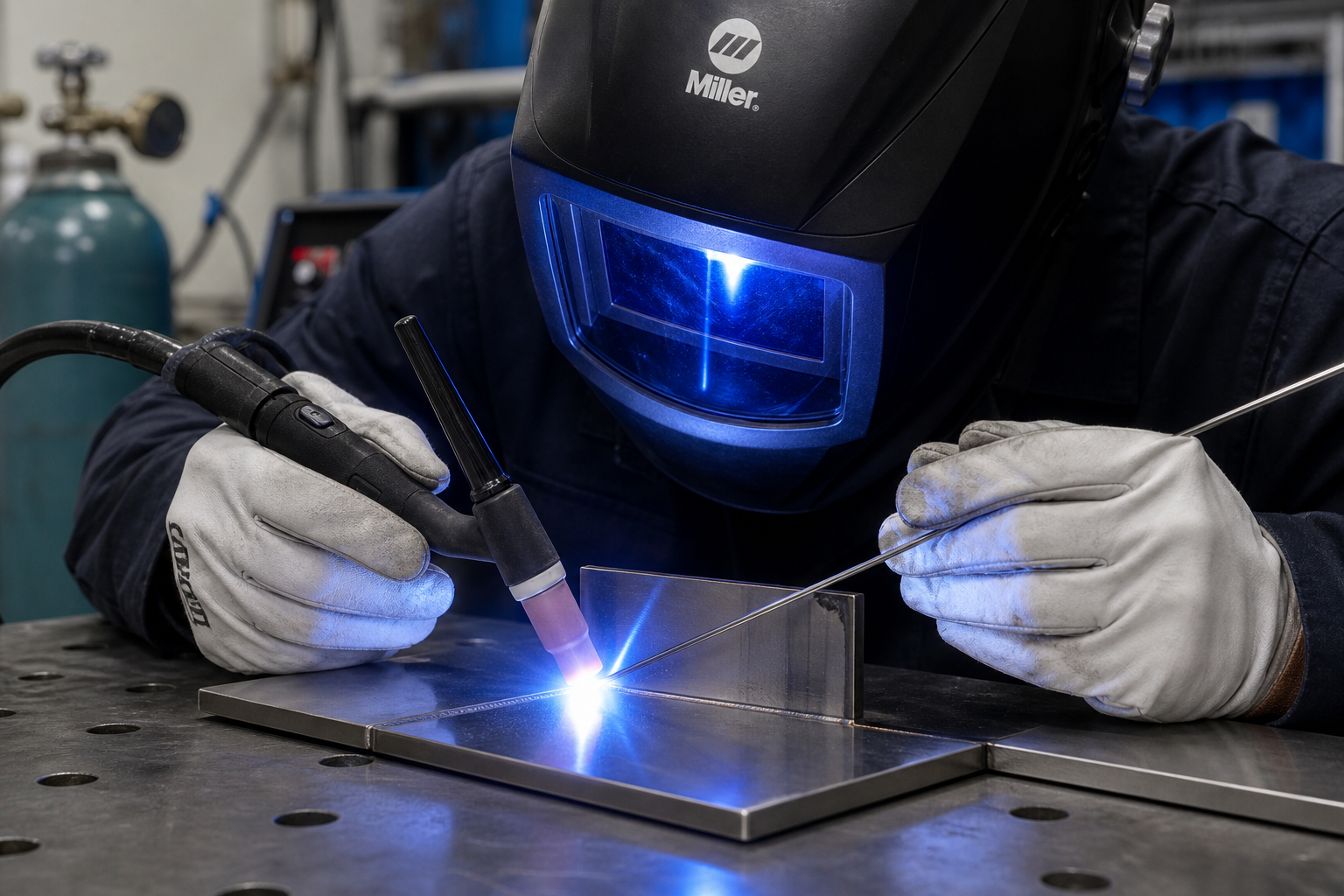
Why TIG, not MIG, on stainless and alu
MIG (gas metal arc) gives you a fast, productive weld on mild steel — but on stainless and aluminium the heat input is too high and the wire-feed contaminates the seam with too much filler. TIG (gas tungsten arc) gives a cleaner, slower, controllable weld with separate filler rod and pure argon shielding. For food-grade kitchens, brewery vessels and any visible decorative seam, TIG is the correct process. We have a Kemppi Master TIG 235 ACDC inverter at the workshop dedicated to it.
- DC TIG for stainless steel — 304, 316L, and most kitchen grades
- AC TIG for aluminium — 5083 and 6082 grade sheet and section
- Pulse function for thin-wall (sub-1.5mm) stainless and aluminium
- Separate tungstens — 2.4mm zirconiated for AC alu, 2.4mm thoriated/lanthanated for DC stainless
- Argon shielding gas — 100% pure for stainless, 100% pure for alu
Commercial-kitchen & food-grade stainless
Commercial-kitchen repairs across Dublin restaurants and cafés — bench legs, splash-back joins, pot-rack repairs, dishwasher landing benches. Anything that's been damaged in service and needs putting back to food-grade Health Service Executive (HSE) standard.
- Bench-top seam repairs on 304 and 316L brushed stainless
- Pot-rack bracket re-welds — common failure point in busy kitchens
- Splash-back and tile-edge stainless re-fitting
- Walk-in cold-room shelving re-attachment — anchor brackets and dunnage racks
- Brewery sample-port and clamp repairs — sub-flush ground seams, dye-pen tested on request
HSE compliance: all food-grade welds are passivated after cooling (citric-acid passivation paste, rinsed) to restore the chromium oxide layer that gives stainless its rust resistance. Without passivation, the weld zone is heat-tinted and corrodes — visible as brown stains within months. We always passivate; some workshops skip it.
Brewery & distillery
Small north-side micro-breweries make up a steady part of the diary. Vessel-bracket repairs, sample-port mods, clamp re-welds, jacket-coil patches. We work to brewery sanitary standard — 3A and IDF dairy-grade where the brewer requires.
- Vessel bracket and conical-tank leg re-welds (304 grade)
- Sample port and racking arm modifications — tri-clamp standard fittings
- Heat-exchanger jacket coil patch welds on existing vessels
- Pipework modifications — TIG butt welds on sanitary tube, ID smooth-finish ground
- Cold-block bench repairs — typical wear-and-tear after a few seasons
For larger vessel work or new-build vessel construction, we sub to a Belfast specialist who has the closed-tank certification we don't.
Decorative balustrade & rail
Brushed stainless balustrade for residential and small-hospitality renovations. Glass-infill panels with stainless clamps, or solid-bar infill with elevation pattern. We TIG every visible seam (it's the look as much as the bond).
- Brushed 304 stainless balustrade rail — 42mm round top rail standard
- Stainless clamps for glass infill panels — Q-railing or compatible
- Domestic and small-commercial Part K residential drop spec (1.1m above finished floor)
- Hospitality reception desk and bar trim work — full TIG, fully passivated
Aluminium fabrication
Aluminium gate frames (lighter than steel, no rust), garden-room sliding-door frame mods, aluminium ladder repairs, marine fittings.
- AC TIG on 5083 and 6082 grade — most common Irish-stocked grades
- Aluminium gate frames — 50×50 or 60×60 SHS, hinged on stainless pins
- Ladder and step repairs — for warehouse and access platform clients
- Marine fittings — for small-craft owners on the north Dublin coast
Aluminium has its own quirks — surface oxide layer melts at 2,000°C while the base metal melts at 660°C, so cleanliness matters more than on steel. We wire-brush every joint with a dedicated stainless brush before welding (no contaminated brushes near alu work).
Cross-contamination — the bit nobody mentions
You'll see other workshops welding stainless on the same bay as mild steel. They shouldn't. Iron particles deposited on a stainless seam during grinding or wire-brushing will start to rust within weeks, even on 316L grade. The whole point of stainless is the chromium-oxide passive layer, which iron contamination breaks down chemically.
Our workshop separates them physically:
- Dedicated stainless-only grinder with a stainless flap-disc kept on a hook on its own
- Stainless-only wire brushes — separately colour-coded blue handles
- Stainless-only clamps and jigs — wiped down between every job
- Citric-acid passivation paste applied to every weld zone before the work leaves the workshop
- No mild-steel grinding swarf within four metres of the stainless TIG bay
It's the kind of thing that's invisible until it rusts six months later. If you've had a stainless job done elsewhere and it's discolouring, ring us — sometimes a re-passivation rescues it; sometimes the seam has to be ground out and re-welded.
What it costs
- Workshop TIG hourly: €110 per hour, fifteen-minute blocks
- Drop-off / collection at workshop: free inside our regular area
- Stainless or aluminium stock: trade-merchant receipt + 12% handling
- Passivation paste, citric-acid rinse: included on every food-grade job
- Dye-pen NDT (where brewer requires for vessel work): €120 per inspection
- VAT at 23% added on the totals shown on the quote